
Mohali | 19 October 2026. A proposed expansion of Fortis Hospital’s healthcare infrastructure in Mohali has received a conditional clearance from the Punjab and Haryana High Court relating to the removal of trees on the project site. The court permitted the hospital to fell 22 trees only after it undertook to plant 110 replacement saplings and care for them for a decade.
By Harpreet Gaba | Speedy Clicks News Room
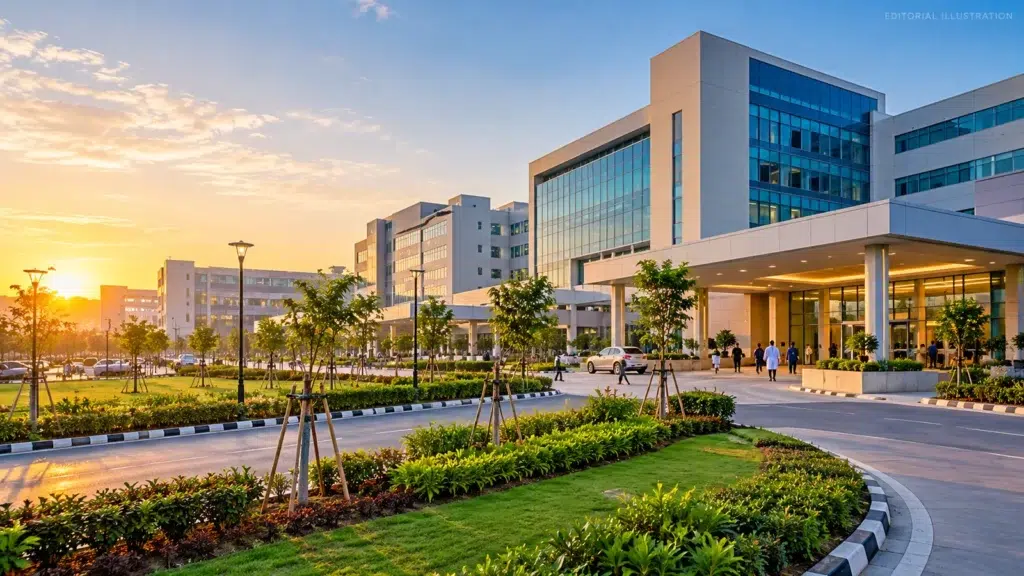
Featured image: Original editorial illustration of a healthcare campus. It is not a photograph of Fortis Mohali or the court proceedings.
The development has two distinct dimensions for the Mohali business and healthcare community: it clears a specific legal obstacle for planned medical-facility expansion, while setting measurable environmental obligations for the institution. The order does not, by itself, establish when new construction will be completed or when any additional services will begin.
What the High Court permitted
According to The Tribune’s 17 October report, a Division Bench headed by Chief Justice Ashwani Kumar Mishra and Justice Rohit Kapoor considered an undertaking submitted on the hospital’s behalf by facility in-charge Abhijit Singh. The hospital is seeking to expand existing healthcare infrastructure on approximately 5.028 acres allotted by the Greater Mohali Area Development Authority (GMADA).
The permission addresses the felling of 22 trees on that land. It is subject to compensatory planting at a five-to-one ratio. The 110 saplings are to be planted within the premises at locations identified in the site plan submitted to the court, with species corresponding to those being removed.
Tree planting requirements are part of the approval
The reported conditions go beyond planting a fixed number of trees. They include:
- 110 replacement saplings for the 22 trees permitted to be removed.
- Individual geo-tagging of saplings to make the plantation identifiable and traceable.
- A 10-year maintenance obligation, including suitable watering, protection and monitoring.
- Periodic visual documentation of survival and growth, with public-facing reporting expectations noted in the coverage.
Hindustan Times also reported the geo-tagging condition. These requirements matter because they create longer-term duties rather than treating tree replacement as a one-day event. Whether the planting and survival targets are ultimately achieved will need to be established through subsequent compliance records.
Why the development matters to Mohali’s healthcare economy
Mohali’s healthcare sector is part of a wider Tricity services ecosystem, serving patients, families, visiting professionals and medical suppliers from Chandigarh, Panchkula, Zirakpur and beyond. Additional hospital infrastructure, once approved and operational, can improve the ability of a healthcare provider to expand capacity or facilities. However, no verified figure for additional beds, investment value, hiring or expected opening dates was specified in the cited court-approval coverage.
For local businesses, the more immediate story is the balance between institutional expansion and enforceable environmental responsibility. The court’s conditions illustrate how a project seeking to develop its site can be required to take explicit, measurable steps to protect and replenish green cover.
What happens next
The next milestones are compliance with the tree-felling permission, planting and geo-tagging of the saplings, and any separately announced construction or operational timeline. Patients and businesses should not interpret the court’s decision as an announcement that new hospital facilities are already open.
For more updates on local innovation and enterprise, explore the Speedy Clicks Tricity News Room.
Sources and reporting note
This article is based on The Tribune’s 17 October 2026 reporting and Hindustan Times’ account of the geo-tagging directions. Speedy Clicks has not independently reviewed every page of the court file, inspected the site or verified future capital expenditure or tree survival. The featured image is an illustration.